Hi there! If you love rich, milky sweets with a gentle coconut flavour, you are going to adore Sri Lankan milk toffee.
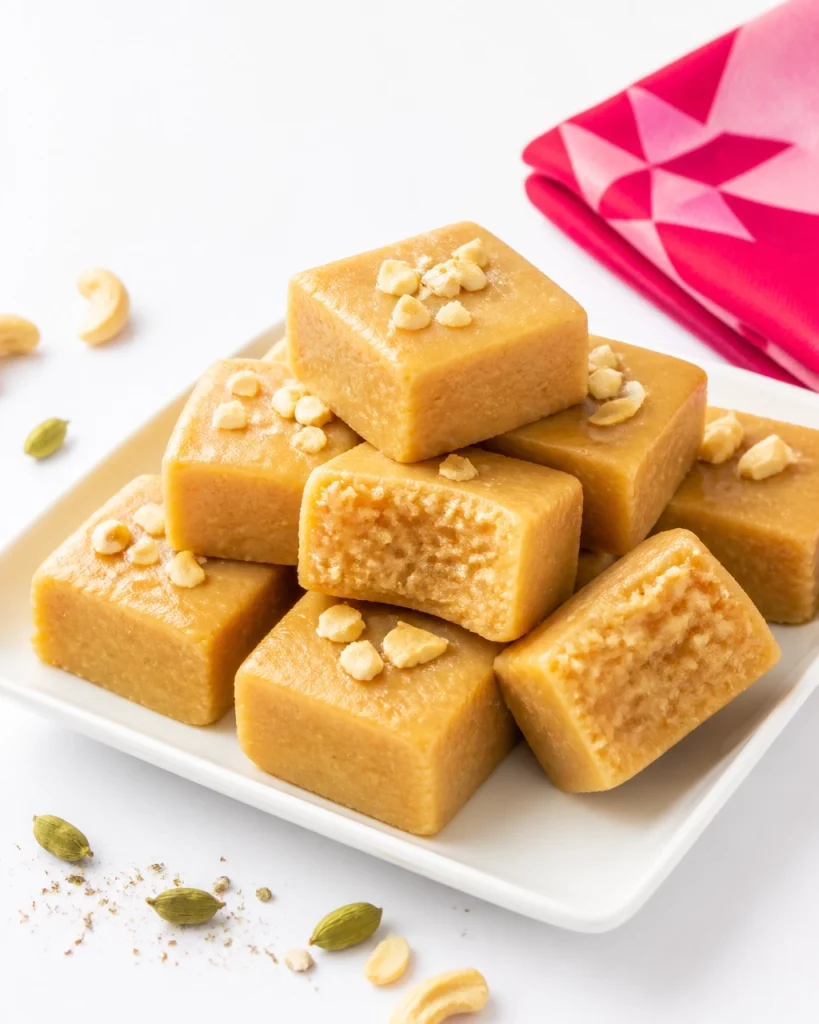
Known as kiri toffee or kiri aluwa, this beloved sweet is soft, chewy, and wonderfully fragrant. Each square melts in your mouth, with little pops of roasted cashew and cardamom running through the mixture.
Milk toffee is a familiar sight at Sri Lankan parties, family gatherings, weddings, and tea tables. It is also a favourite on Sinhala and Tamil New Year spreads, where it sits proudly beside other traditional Sri Lankan dishes and festive sweets such as kavum, kokis, and aluwa.
The recipe is simple. The stirring is the real workout (consider it your arm-day contribution). Follow the texture cues below, and you can make a batch of neat, creamy milk toffee at home.
What makes Sri Lankan milk toffee special?
This homemade sweet combines condensed milk, milk powder, coconut milk, and sugar. The mixture cooks slowly until it becomes thick and glossy. Once cooled, it sets into tender fudge squares that are firm enough to hold but soft enough to bite easily.
Coconut milk adds a subtle tropical richness. Milk powder gives the toffee its creamy body, while condensed milk brings deep milky sweetness. Cardamom and cashews are optional, but they add the festive touch many families love.
If you are building your Sri Lankan pantry, explore our Sri Lankan grocery collection and browse more ideas in our Sri Lankan sweets guide.
Ingredients
Makes approximately 25– thirty small squares.
- 1 cup coconut milk
- 1 cup granulated sugar
- 1 can sweetened condensed milk, approximately 390–400 g
- 1½ cups full-fat milk powder
- 2 tablespoons unsalted butter, plus extra for greasing
- ½ cup roasted cashews, finely chopped (optional)
- ½ teaspoon ground cardamom, or the seeds from 5–6 cardamom pods (optional)
- 1 teaspoon vanilla extract (optional)
For coconut milk, use a good-quality product from the Sri Lanka Stores coconut products category. You can find milk powder and condensed milk through the dairy products category. For sugar, cashews, and spices, visit the Sri Lankan grocery guide.
You will also need
- A heavy-bottomed saucepan
- A wooden spoon or heatproof spatula
- An 8-inch square tray or similar shallow dish
- Baking paper, optional
- A buttered knife for cutting

How to make Sri Lankan milk toffee
1. Prepare the tray
Grease your tray generously with butter. If you are using baking paper, line the tray first, then butter the paper as well.
Do not skip this step. Milk toffee becomes wonderfully sticky while warm, and you do not want to wrestle it out of the tray later (the tray will win).
Butter your knife and spatula too. You will thank yourself when it is time to spread and cut the mixture.
2. Dissolve the sugar in coconut milk
Pour the coconut milk into a large, heavy-bottomed saucepan. Add the sugar and place the pan over medium heat.
Stir until the sugar dissolves completely. The mixture should look smooth, with no dry sugar sitting at the bottom of the pan.
Keep the heat moderate. High heat may make the mixture boil too aggressively or catch on the bottom.
3. Add the condensed milk
Pour in the condensed milk and stir well to combine.
The mixture will become pale, creamy, and quite liquid at this stage. Keep stirring as it warms. Once it starts bubbling gently, reduce the heat to medium-low.
A larger saucepan is useful here because milk mixtures can rise quickly when they boil.
4. Add the milk powder
Sift the milk powder if it looks lumpy. Add it gradually, a little at a time, while stirring constantly.
This helps prevent dry pockets and reduces the chance of a grainy finished toffee. Keep scraping the base and corners of the pan as you stir.
At first, the mixture will resemble a thick custard. As it cooks, it will become heavier and more difficult to move.

5. Cook until thick and glossy
Continue stirring constantly over medium-low heat. This is the patience section.
The mixture may take 25–45 minutes to reach the right consistency, depending on the size of your pan and the heat level. Do not walk away. Milk toffee can scorch quickly once it thickens.
You are looking for these signs:
- The mixture becomes thick and glossy.
- It falls from the spoon in heavy, broken drops rather than a continuous ribbon.
- A line drawn through the mixture briefly remains visible.
- The mixture pulls away from the sides of the pan.
- It gathers around the spatula as one soft, pliable mass.
If using a thermometer, aim for approximately 112–116°C (234–240°F), the soft-ball stage. However, visual cues are especially useful for this recipe.
6. Add butter, cardamom, and cashews
When the mixture is almost ready, add the butter, cardamom, vanilla, and chopped cashews.
Stir thoroughly until the butter melts and everything is evenly distributed. The mixture should look smooth and shiny.
Cook for another minute or two, but do not over-boil. The toffee continues to firm as it cools.
7. Pour into the tray
Immediately transfer the hot mixture to your buttered tray.
Use the buttered spatula to spread it into an even layer. Work quickly but carefully. The mixture will begin to set as soon as it leaves the saucepan.
Aim for a thickness of about 1–1½ cm. Thicker pieces feel more like fudge, while thinner pieces set slightly firmer.
8. Score and cool
While the mixture is still warm, score it into squares or diamonds with your buttered knife.
Do not wait until it cools completely. Once set, milk toffee becomes much harder to cut cleanly and may crumble around the edges.
Leave the tray at room temperature until fully cool. Then separate the pieces and arrange them on a serving plate.

Pro tips for the perfect texture
Stir constantly
This is the most important rule. Stir from the bottom and around the edges throughout cooking. Constant movement prevents scorching, uneven cooking, and sugar crystals.
Do not over-boil
If you cook the mixture too far, your milk toffee may become hard, dry, or difficult to bite. Remove it when it is thick, glossy, and pulling away from the pan: but still soft and pliable.
Grease everything
Butter the tray, spatula, and knife. This small step makes spreading and cutting much easier.
Test before transferring
Drop a small amount of the mixture into a cup of cold water. It should form a soft ball that holds together but flattens easily when pressed.
If it dissolves immediately, keep cooking. If it forms a hard ball, the mixture has gone too far.
Cut while warm
Score the toffee as soon as you spread it. You can make squares, diamonds, or small rectangles. Diamonds look especially lovely on a festive table.
Troubleshooting Sri Lankan milk toffee
Why is my toffee grainy?
The sugar may have crystallised, or the milk powder may not have been incorporated smoothly. Add the milk powder gradually, stir constantly, and avoid cooking over high heat.
A heavy saucepan also helps maintain an even temperature.
Why is my toffee sticky?
It probably needed more cooking time. Sticky, gummy toffee has not reached the soft-ball stage.
Return the mixture to the saucepan and cook it gently for a little longer, stirring continuously. If it has already cooled in the tray, you can carefully scrape it back into the pan.
Why is my toffee too hard?
It was likely overcooked. Next time, remove it as soon as it pulls away from the pan and passes the cold-water test.
Hard pieces can still be chopped and served with tea, but they may not have that soft, melt-in-the-mouth texture you want.
Why is my toffee too soft?
The mixture may have been removed from the heat too early, or the layer may be unusually thick. Cook it for a few extra minutes next time and watch for the broken-drop and pan-pulling cues.
How to serve milk toffee
Serve Sri Lankan milk toffee at room temperature with a cup of tea or coffee. It is perfect for afternoon visitors, holiday platters, and party dessert tables.
For a traditional celebration spread, serve it alongside:
- Kiribath, or Sri Lankan milk rice
- Seeni sambol
- Kokis
- Kavum
- Sri Lankan butter cake
- Fresh fruit and black tea
Store the cooled squares in an airtight container at room temperature. Separate layers with baking paper. They are best enjoyed within a few days, although they may last longer in a cool, dry cupboard.
Watch and Learn: How to Make Milk toffee
Sometimes seeing the technique in action makes all the difference. Check out this fantastic video :
Once you make this sweet successfully, you will understand why it appears at so many Sri Lankan celebrations. It is rich, nostalgic, and wonderfully shareable.
So grease that tray, find your favourite wooden spoon, and get stirring. Your next tea table is about to become much more delicious. Have fun!